South Carolina Bike Laws: What You Need to Know (2025)
South Carolina bike laws: what you need to know about road rules, dirt bikes, e-bikes, registration hurdles, and street-legal safety equipment.

South Carolina bike laws: what you need to know begins with a fundamental principle under state code, bicycles are defined as vehicles with full rights to use public roadways. Under South Carolina Code of Laws Title 56, Chapter 5, Article 27, anyone operating a bicycle on a public roadway is granted all rights and is subject to all duties applicable to the driver of any motor vehicle, except for special regulations or provisions that by their nature cannot apply. Whether you pedal a standard road bicycle along coastal routes, commute via an electric bike in Columbia, or want to understand motorized cycle classifications, knowing these standards keeps you safe and compliant.
Understanding roadway rules in the Palmetto State goes beyond basic cycling etiquette. State statutes govern exactly where you can ride, how vehicles must pass you, what safety gear is required by law, and how motorized two-wheelers are treated under Department of Motor Vehicles regulations. Dirt Legal provides clear breakdowns of complex vehicle titling and roadway statutes so riders can work through the pavement with total confidence.
In this guide, you will learn bicycle road rights, lighting and reflector mandates, electric bicycle classifications, helmet regulations, and how off-road bikes fit into the picture if you want to ride on public streets.
South Carolina Bike Laws: What You Need to Know About Roadway Rights
Updated on October 15, 2026
South Carolina Code Section 56-5-3420 establishes that bicyclists have the right to occupy travel lanes on public roads across the state. Cyclists are not limited to sidewalks or specialized paths. In fact, many municipal jurisdictions explicitly prohibit adult bicycle riding on commercial sidewalks due to pedestrian conflict risks. When riding on public roads, cyclists must travel in the same direction as motorized traffic, obeying all official traffic control devices, stop signs, and traffic lights just as any automobile driver must.
Where Cyclists Must Ride on the Road
State law mandates that any person operating a bicycle upon a roadway at less than the normal speed of traffic must ride as near to the right side of the roadway as practicable. There are critical statutory exceptions that every rider should know. You are not required to hug the curb or road edge when overtaking and passing another bicycle or vehicle, when preparing for a left turn at an intersection or into a private driveway, or when reasonably necessary to avoid conditions that make it unsafe to continue along the right edge.
Unsafe conditions defined by statute include fixed or moving objects, parked or moving vehicles, other bicycles, pedestrians, animals, surface hazards, or travel lanes that are too narrow for a bicycle and a motor vehicle to travel side by side safely within the lane. When a roadway lane is substandard in width, a cyclist has the right to take the full lane to prevent dangerous, sideswiping maneuvers by passing cars.
Riding Two Abreast and Group Cycling
Bicyclists riding upon a roadway in South Carolina must not ride more than two abreast, except on paths or parts of roadways set aside for the exclusive use of bicycles. When riding two abreast, cyclists must not impede the normal and reasonable movement of traffic. On narrow, winding two-lane roads without shoulders, dropping into single-file formation when motor traffic approaches from behind is not only common sense, but it also aligns with the statutory requirement to prevent unnecessary traffic obstruction.
The Safe Passing Law for Motor Vehicles
South Carolina Code Section 56-5-3445 requires the driver of a motor vehicle overtaking a bicycle proceeding in the same direction to exercise due care. Motorists must maintain a safe operating distance of not less than three feet between the vehicle and the bicycle until safely past. If the lane is not wide enough to pass with at least three feet of clearance, the motorist must wait until oncoming traffic clears and make a standard lane change to pass safely.
Harassment of cyclists is also addressed in state statutes. It is unlawful to throw objects at cyclists or intentionally maneuver a vehicle in a threatening manner toward someone riding a bicycle. Violations carry misdemeanor penalties and financial fines for motorists.
South Carolina Bike Laws: What You Need to Know Regarding Equipment Mandates
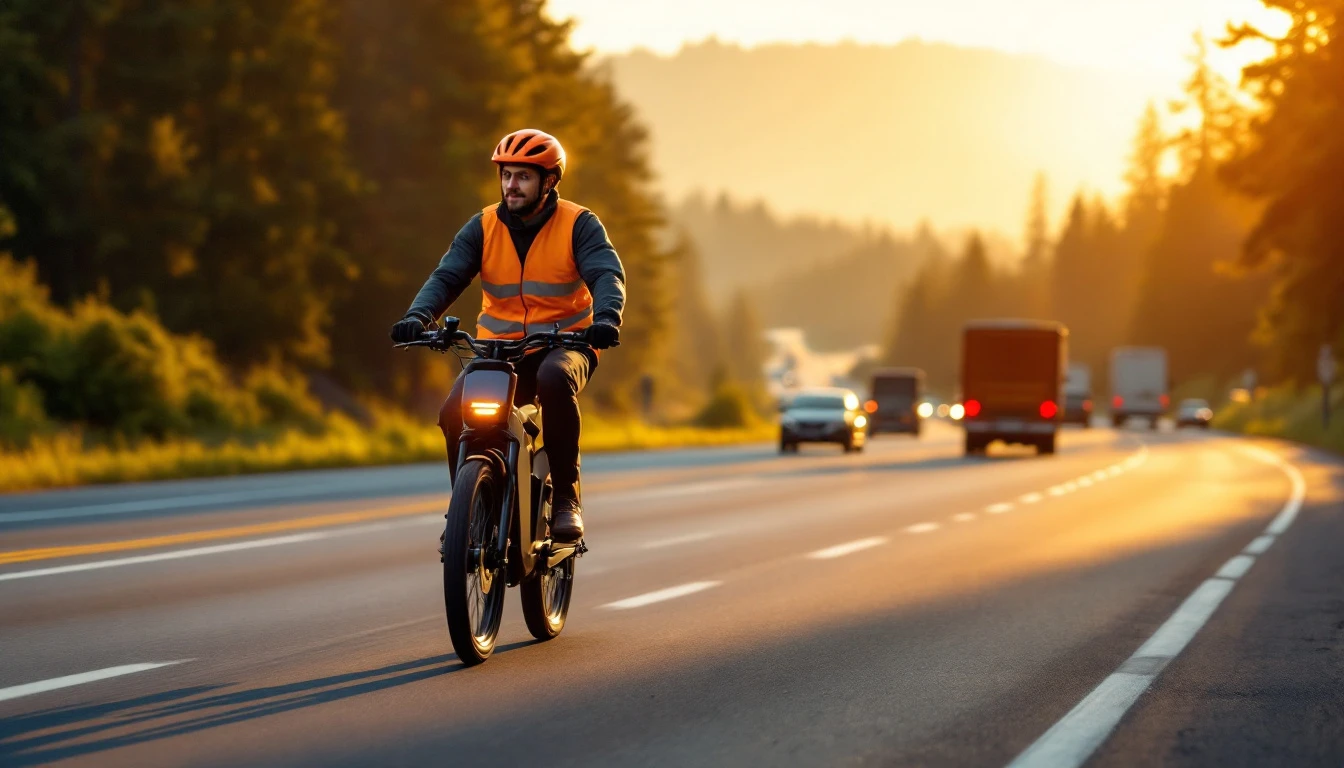
South Carolina law establishes clear mechanical and visibility criteria for any bicycle ridden after dark or on state highways. Bicycles may seem basic compared to automobiles, but failing to meet statutory equipment minimums can result in traffic citations and severely weaken your position if an accident occurs.
Ready to register your vehicle?
Join thousands of vehicle owners who use Dirt Legal to handle their registration quickly.
Lighting Requirements for Night Riding
According to South Carolina Code Section 56-5-3470, every bicycle used at nighttime must be equipped with a lamp on the front that emits a white light visible from a distance of at least 500 feet to the front. For the rear, the bicycle must have a red reflector visible from all distances from 50 feet to 300 feet to the rear when directly in front of the upper beams of headlamps on a motor vehicle.
A lamp emitting a red light visible from a distance of 500 feet to the rear may be used in addition to or in place of the red reflector. Serious cyclists often combine an active, pulsing rear red LED light with passive red reflectors to make sure they are visible under all ambient street lighting conditions.
Braking Systems and Mechanical Standards
Every bicycle operated on South Carolina roadways must be equipped with a brake that enables the operator to make the braked wheels skid on dry, level, clean pavement. Fixed-gear bicycles without hand brakes must rely on a drivetrain brake mechanism capable of stopping the bike within safe, controlled distances. Handlebars must also be positioned so that the operator is not required to carry hands higher than shoulder height when gripping the controls.
Helmet Laws for Children and Adults
South Carolina does not have a statewide bicycle helmet mandate for adult pedal cyclists. Minors under certain ages may be encouraged by local programs to wear protective headgear, but state traffic code does not enforce an across-the-board helmet citation system for traditional bicycles. However, wearing a helmet certified by the Consumer Product Safety Commission significantly reduces severe head trauma risks during a crash.
Helmets become mandatory when you transition into motorized platforms. If you operate a moped or motorcycle and are under 21 years of age, South Carolina law explicitly requires an approved helmet and eye protection. For general pedal cyclists, safety advocacy groups universally recommend helmet usage regardless of statutory exemptions.
South Carolina Bike Laws: What You Need to Know About Electric Bikes (E-Bikes)
Electric bicycles occupy a distinct category in South Carolina that separates them from mopeds, scooters, and traditional motor vehicles. South Carolina adopted standard model e-bike legislation to define how low-speed electric bicycles operate on public roads and multi-use paths.
The Three-Tier E-Bike Classification System
Under state statutory definitions, an electric-assisted bicycle is equipped with fully operable pedals and an electric motor of 750 watts or less. The vehicle falls into one of three distinct classes:
- Class 1 E-Bike: Equipped with a motor that provides assistance only when the rider is pedaling and ceases to provide assistance when the bicycle reaches a speed of 20 miles per hour.
- Class 2 E-Bike: Equipped with a motor that may be used exclusively to drive the bicycle (throttle operation) but ceases to provide assistance when the bicycle reaches a speed of 20 miles per hour.
- Class 3 E-Bike: Equipped with a motor that provides assistance only when the rider is pedaling and ceases to provide assistance when the bicycle reaches 28 miles per hour. Class 3 models must also have a speedometer.
Electric bicycles matching these specifications do not require a driver's license, state motor vehicle registration, or liability insurance policy to ride on public streets where bicycles are allowed.
Where Can You Ride Electric Bikes?
Class 1 and Class 2 electric bicycles may be operated on roadways, marked bicycle lanes, and multi-use paths unless a local municipality or county explicitly passes an ordinance barring motorized assistance on specific pedestrian pathways. Class 3 bicycles are primarily intended for roadway use or adjacent bicycle lanes due to their higher travel speeds. State parks and municipal greenways frequently post localized regulations, so riders should check local municipal codes in cities like Charleston, Greenville, or Myrtle Beach before hitting multi-use recreational paths.
Understanding out-of-state rules is equally valuable for traveling riders. A more detailed breakdown of neighboring standards is available in Minnesota bike laws: what you need to know. That resource covers how other states structure equipment mandates and access rights for e-bikes and urban commuters.
South Carolina Bike Laws: What You Need to Know for Mopeds, Dirt Bikes, and Powersports
Many riders confuse pedal bicycles, e-bikes, mopeds, and off-road dirt bikes. South Carolina maintains strictly separated statutory definitions for these machine categories. Knowing where your two-wheeler lands determines whether you need a title, registration, or driver's license.
South Carolina Moped Regulations
South Carolina defines a moped as a cycle with pedals or without pedals, with an engine displacement not exceeding 50 cubic centimeters, producing not more than two brake horsepower, and capable of a maximum speed not exceeding 30 miles per hour on level ground. Unlike traditional bicycles, mopeds must be registered with the South Carolina Department of Motor Vehicles and display a valid license plate. Operators must be at least 15 years old and hold a valid moped license or standard driver's license. Mopeds cannot travel on interstate highways or expressways.
Can You Ride an Off-Road Dirt Bike on South Carolina Public Roads?
Factory dirt bikes are manufactured for off-highway competition and trail use. They lack basic street equipment like turn signals, mirrors, high and low beam headlights, brake lights, and horn units. Most importantly, manufacturers issue a Certificate of Origin stating the vehicle is designed solely for off-road use. Under South Carolina law, you cannot ride an unregistered, uninspected off-road machine on public roads.
Converting a dirt bike into a street-legal platform requires installing the appropriate safety equipment, acquiring proper titling documentation, and obtaining a street license plate. South Carolina local DMVs do not offer straightforward conversion pathways for machines originally designated for off-road use only.
The Solution for Off-Road Bike Owners
Riders who own trail bikes, dual-sport projects, or utility powersports often face insurmountable state DMV roadblocks when attempting to get plates. This is where out-of-state titling and registration frameworks provide a viable path forward. By establishing an LLC in an enthusiast-friendly state such as Montana, you can title and register your machine. Dirt Legal helps enthusiasts across the country handle this transition smoothly.
Dirt Legal has completed over 6,000 customer orders to date (internal data, lifetime through current month, n=6,385), proving that proper paperwork removes the headaches from powersports titling. If you want to change your dirt bike into a street-legal dual-sport, look at our guide on how to get a title for a motorcycle. This resource explains the steps needed to establish proof of ownership when missing or non-highway documents prevent progress.
You can also check our full range of services on our Street-Legal Vehicle registration assistance services page to see how our team handles the filings required to plate unconventional vehicles.
Comparison of Two-Wheel Vehicle Regulations in South Carolina
Understanding which rules apply to your two-wheeled ride prevents costly tickets and impoundments. The following table illustrates how South Carolina law distinguishes between standard bicycles, electric bicycles, mopeds, and off-road dirt bikes.
| Vehicle Category | Speed / Engine Limit | Driver License Required? | Registration / Plate Required? | Street-Legal Road Access |
|---|---|---|---|---|
| Standard Bicycle | Human powered | No | No | All surface streets; no limited-access interstates |
| Class 1 & 2 E-Bikes | 20 mph assist max / 750W | No | No | Public roads and designated multi-use paths |
| Class 3 E-Bike | 28 mph assist max / 750W | No | No | Public roadways and marked on-road bike lanes |
| Moped | 50cc or less / 30 mph max | Yes (Class G or higher) | Yes (SC Moped Plate) | Surface streets; prohibited on interstates |
| Factory Dirt Bike | Various (Off-road only) | Yes (Motorcycle class) | Yes (Motorcycle plate required) | Prohibited on public roads without full conversion |
South Carolina Bike Laws: What You Need to Know About Titling and Registration
Vehicle ownership documentation is the cornerstone of riding any motorized platform on public streets. If you buy a motorized cycle or scooter, title documentation determines whether you can register it. In private sales, issues frequently arise around document transfer protocols.
Avoiding Title Jumping and Transfer Traps
When purchasing a motorized cycle, moped, or motorcycle, always make sure the seller provides an accurately signed title in their own name. A non-compliance practice known as title jumping occurs when a buyer purchases a vehicle, fails to title it in their name, and immediately resells it to another party. In many states, this is also referred to as title floating. Both practices create major administrative blocks at the DMV because the chain of ownership is broken.
If you encounter title jumping issues when purchasing an off-road bike or project motorcycle, you will face rejected paperwork at the counter. For a broader explanation of titling procedures when acquiring non-standard vehicles, review our guide on do i need a POA to register my car?. It explains how POA documentation functions during remote vehicle title processing.
Managing Out-of-State Registrations and Montana LLCs
Many powersport enthusiasts choose out-of-state solutions to register custom builds, imported motorcycles, or dual-sport conversions. By forming a Montana LLC, the entity owns the vehicle, allowing you to secure permanent or standard registration without paying retail sales tax. This approach is completely recognized across state lines under reciprocal registration compacts. Learn more on our Montana LLC Services overview page.
For owners exploring alternative states, South Dakota also offers a streamlined non-resident registration system for various vehicle classifications. Sister brand Ride Legal offers extensive insights into these setups, including their detailed guide on How a Motorcycle Registration Service Online Simplifies Ownership.
Additionally, you can read about sales tax nuances in the region by checking What Is the Sales Tax on a Car in South Carolina?. That resource clarifies how local property taxes and infrastructure maintenance fees affect vehicle owners in the state.
Frequently Asked Questions About South Carolina Bike Laws
Are dirt bikes street-legal in South Carolina?
Factory dirt bikes are not street-legal in South Carolina straight from the dealership. To operate a dirt bike on public roads, the machine must meet all motor vehicle safety requirements, including headlights with high and low beams, functional taillights, brake lights, DOT-approved tires, rearview mirrors, a horn, and turn signals. It must also have a valid title, state registration, and license plate. Because South Carolina DMVs rarely convert off-road titles, owners frequently work with private registration specialists like Dirt Legal to title their bikes out of state through a Montana LLC or South Dakota process.
Do dirt bikes need to be registered?
Dirt bikes operated strictly on private property or designated off-road riding parks do not need state registration. However, if you plan to operate your dirt bike on any public roadway, street, or highway, it must be registered and display a valid license plate. Operating an unregistered dirt bike on public streets can lead to heavy moving violation fines, vehicle impoundment, and towing charges.
Do I need a license to ride a dirt bike?
You do not need a driver license to ride a dirt bike on private land or sanctioned off-road tracks. If your dirt bike has been converted into a street-legal machine and registered for road use, you must hold a valid driver license with a motorcycle endorsement (Class M in South Carolina) to ride on public streets and highways. Operating a street-legal motorcycle without the proper license endorsement carries criminal misdemeanor penalties.
What does a dirt bike need to be street-legal?
To be street-legal, a dirt bike must be equipped with full highway safety hardware: a DOT-compliant headlight with high and low beam indicator, a running tail light wired to front and rear brake switches, front and rear turn signals, at least one rearview mirror, a functioning horn audible from 200 feet, DOT-approved road tires, and an illuminated license plate bracket. The bike must also have valid road registration and proof of minimum liability insurance coverage.
What do I need to register a vehicle in South Dakota?
To register a vehicle in South Dakota as a non-resident, you need the original vehicle title or manufacturer certificate of origin (MSO), a completed South Dakota Title and Registration Application (Form MV-608), a copy of your valid government-issued driver's license, and payment for applicable title fees and wheel taxes. South Dakota allows out-of-state residents to register vehicles without visiting a local office, making it a popular choice for dual-sport bikes and specialty motor vehicles.
What you need to know about car accidents involving bicycles?
If you are involved in a motor vehicle accident while riding a bicycle in South Carolina, state law treats the incident identically to a multi-vehicle traffic collision. You must call local law enforcement immediately to file an official collision report, remain at the scene, and exchange insurance and contact information. Because South Carolina follows a modified comparative negligence rule (51% bar), an injured cyclist can recover damages from an at-fault driver as long as the cyclist was not more than 50% responsible for the collision.
Can bicycles ride on the sidewalk in South Carolina?
South Carolina state law does not universally prohibit riding bicycles on sidewalks, but it grants local municipalities the authority to regulate or ban sidewalk riding. Major cities like Charleston and Columbia ban sidewalk cycling in dense business districts to protect pedestrians. Where sidewalk riding is permitted, cyclists must yield the right-of-way to pedestrians and give an audible signal before passing.
Final Thoughts on South Carolina Bike Regulations
South Carolina bike laws: what you need to know comes down to understanding your vehicle classification, respecting roadway rights, and maintaining mandatory safety equipment. Cyclists have an established right to share the road, provided they follow standard traffic signals and maintain visibility during low-light conditions. motorized two-wheelers, understanding the fine line between electric bicycles, mopeds, and off-road dirt bikes protects you from unexpected penalties.
If you are struggling to get a title or road plate for an off-road motorcycle or custom powersport build, you do not have to struggle through complex paperwork alone. Dirt Legal provides complete title assistance services, helping riders secure valid registrations and plates across the nation.