Is KTM 300 Street Legal? Highway Conversion Guide
Is KTM 300 street legal? Find factory limitations, mandatory road equipment, state title hurdles, and how to plate your two-stroke bike.
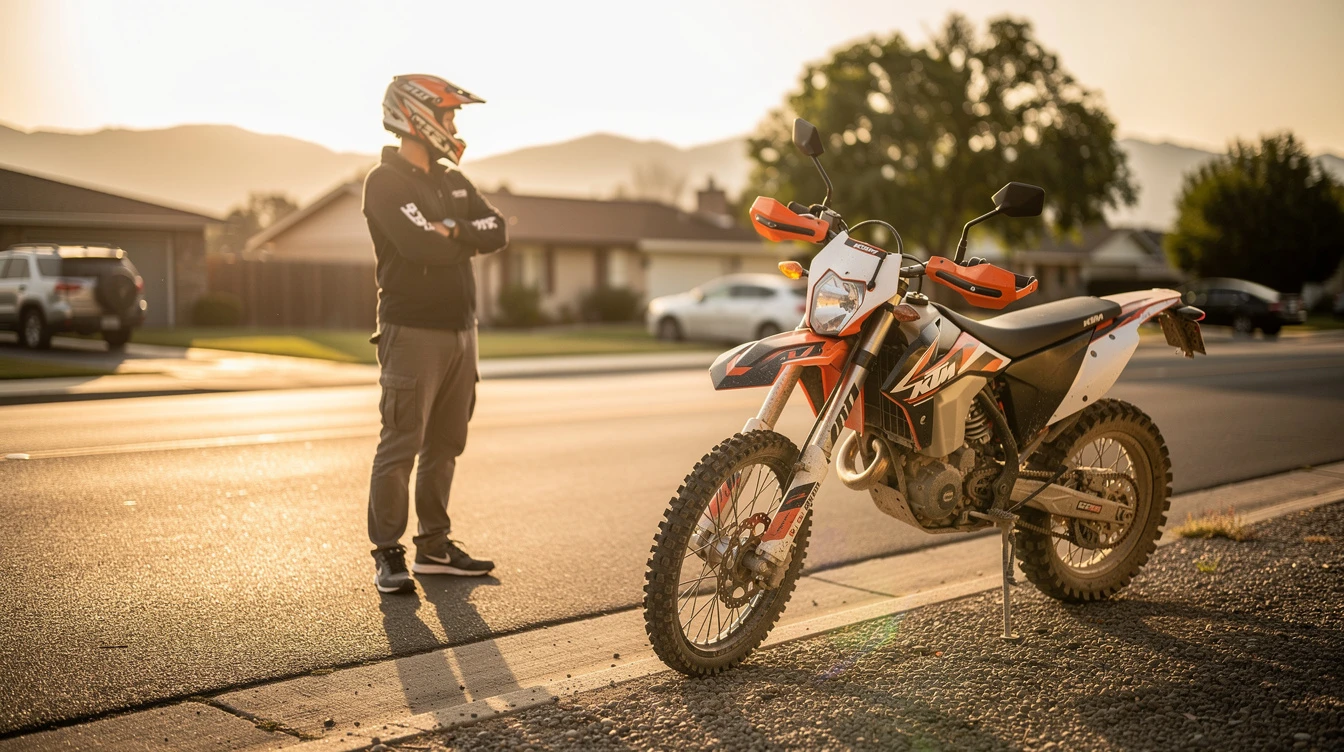
A factory KTM 300 is not street-legal straight from the showroom floor because it lacks Department of Transportation safety equipment and highway emissions certification. However, you can make a KTM 300 street-legal by installing required on-road mechanical hardware and transferring the off-road title to an on-road motorcycle registration.
In This Guide
- Why Is the KTM 300 Not Street-Legal From the Factory?
- What Equipment Makes a KTM 300 Street-Legal?
- How Can You Title and Register a KTM 300 for Road Use?
- How Do State Dirt Bike Conversion Rules Compare?
- Can You Register a KTM 300 Out-of-State?
- Frequently Asked Questions
Why Is the KTM 300 Not Street-Legal From the Factory?
The KTM 300, including both the XC and XC-W iterations, is engineered specifically as a closed-course competition or off-highway trail motorcycle. Factory models lack the required Department of Transportation (DOT) safety equipment, such as turn indicators, mirrors, and dual-beam headlights. More critically, their Manufacturer's Certificate of Origin (MCO) explicitly designates the chassis for off-road use only.
An MCO functions as the birth certificate of any motorcycle. When KTM issues an MCO marked with off-road disclaimers, state motor vehicle databases automatically flag the machine as ineligible for standard license plates. This documentation barrier stops most riders before they even begin modifying physical parts.
Emissions compliance creates another hurdle for the legendary two-stroke platform. The Environmental Protection Agency (EPA) enforces strict clean-air thresholds for on-highway motor vehicles. While KTM introduced transfer port injection (TPI) and throttle body injection (TBI) to clean up exhaust gases, these fuel delivery systems are tuned to meet off-highway standards rather than federal street benchmarks. You can verify federal chassis classifications by checking your VIN with the NHTSA VIN Lookup tool.
Without federal highway compliance labels affixed to the frame neck, municipal motor vehicle agencies reject routine registration requests. Passing local requirements demands both mechanical compliance and administrative reclassification.
What Equipment Makes a KTM 300 Street-Legal?

Converting a KTM 300 for highway use requires adding components that meet state equipment statutes and federal motor vehicle safety guidelines. Most state vehicle codes mandate functional lighting, audible warning devices, and road-rated rubber. Installing an aftermarket dual-sport kit typically fulfills the hardware portion of the transformation.
Ready to register your vehicle?
Join thousands of vehicle owners who use Dirt Legal to handle their registration quickly.
Before scheduling an equipment inspection or submitting road paperwork, make sure your build includes these specific components:
- High and Low Beam Headlight: The forward headlight must include a handlebar-mounted toggle switch, a high-beam dash indicator lamp, and a DOT-stamped lens.
- Brake Light with Dual Switches: Your tail assembly must clarify when applying either the front hand brake lever or the rear foot pedal.
- Rearview Mirrors: Most states require at least one mirror on the left handlebar, though installing dual folding mirrors ensures broad compliance.
- DOT-Approved Tires: Factory knobbies often feature an "Off-Highway Use Only" stamp. You must swap them for dual-sport tires with a visible DOT approval mark.
- Electric Horn: A dedicated horn powered by the bike's twelve-volt electrical system or an auxiliary battery pack is mandatory.
- Turn Signals: While some regions allow hand signals, most modern highway statutes require front and rear amber turn indicators spaced at regulatory widths.
- Illuminated License Plate Bracket: Your rear tag must sit securely with a white light illuminating the registration numbers after dark.
Electrical demands deserve special attention on two-stroke builds. Modern KTM 300 XC and XC-W models carry lightweight stator assemblies intended to run minimal electronics. Adding high-draw lighting can drain the factory battery, so switching to low-draw LED equipment keeps the electrical use stable.
How Can You Title and Register a KTM 300 for Road Use?
Securing a street title for a KTM 300 requires converting the title brand from off-road to on-road status. Because local clerks inspect titles for restrictive phrasing like "For Off-Road Use Only," direct applications at local branches often lead to immediate rejections. Successful riders work through structured administrative procedures to establish road eligibility.
The standard titling path involves several concrete actions:
- Assemble Ownership Documents: Gather your existing title, MCO, or a detailed bill of sale verifying clean ownership and clear VIN status.
- Complete Mechanical Upgrades: Mount your DOT lighting, horn, mirrors, and street tires so the bike can satisfy a physical safety inspection.
- Undergo Vehicle Inspection: Depending on the state, a highway patrol officer or certified mechanic must verify the VIN and sign an equipment certification form.
- Submit Reclassification Paperwork: File the inspection sheet, title application, and ownership transfer forms to request an unrestricted motorcycle title.
- Mount Road Plates: Secure your metal license plate, install current validation decals, and store registration cards onboard during street travel.
If you recently purchased a bike without clean documentation, you must resolve ownership history first. A detailed breakdown is available in Have a Motorcycle With No Title? Here’s How to Get One. That resource clarifies how to reconstruct paper trails when dealing with missing titles on older bikes.
Riders operating in southeastern regions face distinct state agency rules. You can study state-level conversion nuances in How to Register a Dirt Bike in FL for Street Use. This guide explains regional paperwork policies for converting trail machinery.
Understanding operating requirements is just as important as securing plates. Take time to review Do You Need a Motorcycle License to Ride a Dirt Bike?. That resource highlights licensing classifications required before you pull onto public asphalt.
Dirt Legal has completed over 6,000 customer orders to date (lifetime through current month, n=6,414), showing how common it is for powersport owners to seek out-of-state paperwork solutions when home-state bureaucracies shut down conversions.
Make Your Dirt Bike Street-Legal →
How Do State Dirt Bike Conversion Rules Compare?

State motor vehicle rules for converting off-road dirt bikes vary drastically across the country. Several states actively help with conversions through simple inspection affidavits, while others run strict title screening programs that block any VIN registered as an off-highway vehicle (OHV). Knowing where your jurisdiction stands saves months of administrative delays.
| Jurisdiction | Physical Inspection Required? | Accepts Off-Road MCOs? | Two-Stroke Road Friendly? | General Conversion Difficulty |
|---|---|---|---|---|
| Montana | No | Yes | Yes | Simplified |
| South Dakota | No (Affidavit only) | Yes | Yes | Simplified |
| California | Yes (Strict CARB) | No (Post-2003 bans) | No | Prohibitive |
| Texas | Yes (Safety inspection) | Varies by county | Moderate | Moderate |
| Florida | Yes | No direct transfer | No | Complex |
States like California maintain rigid emissions standards through the California Air Resources Board (CARB). Under CARB rules, any two-stroke dirt bike manufactured after 2003 cannot be titled for public road use, regardless of added safety hardware. Even if you install turn signals, the local branch will cross-reference the EPA emissions label and reject your application.
In contrast, states with flexible titling frameworks look primarily at road equipment compliance rather than original factory designations. For riders hit with home-state roadblocks, using specialized paperwork solutions provides a viable path forward. Learn more about How Street Legal Works to understand how off-road conversions succeed across state lines.
Can You Register a KTM 300 Out-of-State?
You can register a KTM 300 out-of-state to secure valid street-legal license plates and a permanent motorcycle road title. Non-resident vehicle owners routinely turn to states like Montana and South Dakota because these jurisdictions do not mandate local residency or physical vehicle inspections. This process establishes clear, transferable road documentation.
Montana provides an advantageous structure through business entity registration. By establishing a dedicated Montana limited liability company, your company owns and titles the vehicle in Big Sky Country. For a breakdown of this method, read Why Do People Register Cars in Montana? The Real Reasons Explained. That article outlines the asset protection and titling flexibility offered by the state.
Registering under a corporate umbrella delivers distinct financial advantages as well. Montana levies zero percent sales tax on vehicle purchases, meaning you avoid costly tax bills when titling high-value dual-sport builds. Review the complete workflow in Register Car in Montana: Everything You Need to Know to see how out-of-state assets are cataloged.
You can verify current state vehicle statutes directly through the Montana Motor Vehicle Division. If you prefer professional paperwork handling, look at our Montana LLC Vehicle Registration program or look through our specialized Street-Legal Vehicle registration assistance services. Both packages provide tailored paperwork support for off-road dirt bike owners.
Partner resources also offer valuable guidance for riders managing multi-vehicle fleets. See how digital processing works by reviewing How a Motorcycle Registration Service Online Simplifies Ownership. If you own higher-end machinery, consult the LLC Vehicle Registration Checklist: Exotic Car Guide for structured administrative advice.
Frequently Asked Questions
Is the KTM 300 street-legal?
The KTM 300 is not street-legal straight from the showroom. KTM produces it as an off-highway motorcycle without DOT lighting, road tires, mirrors, or highway emissions certification. However, you can make it street-legal by installing required on-road safety equipment and securing a road-rated motorcycle title and license plate.
Are dirt bikes street-legal?
Factory dirt bikes are rarely street-legal upon leaving the assembly plant. Most are classified strictly for closed-course or trail operation. To operate one on public roads, you must install mandatory highway hardware like lights, horns, and mirrors, then transition the off-road title into an unrestricted on-road motorcycle registration.
Are four-wheelers street-legal?
Standard four-wheelers or all-terrain vehicles (ATVs) are not street-legal from the factory in most states. A handful of jurisdictions permit limited rural road travel, but full highway access requires installing street equipment and registering the machine through accommodating state titling programs that issue legitimate passenger or motorcycle plates.
Are kei trucks street-legal?
Kei trucks imported from Japan can become street-legal in many states once they surpass the 25-year federal import exemption threshold. While some regional motor vehicle agencies impose speed restrictions or outright bans on mini-truck registrations, out-of-state titling programs allow owners to obtain legal road registration and license plates.
Are Mahindra Roxors street-legal?
Mahindra Roxors enter the market as off-highway utility task vehicles, meaning they are not road-legal out of the box. Because they resemble vintage utility vehicles, many owners convert them for asphalt use by mounting street equipment and utilizing out-of-state titling solutions to secure authentic on-road registration.
Are military Humvees street-legal?
Surplus military Humvees (HMMWVs) are sold for off-road use and lack standard federal safety labels. Converting a surplus military Humvee to street-legal status involves verifying VIN documentation, satisfying state safety inspection standards, and applying through non-restrictive vehicle titling states that accommodate former government utility chassis.