How to Register a Military Humvee for Street Use
Wondering how to register a military Humvee for street use? Learn titling rules, SF-97 requirements, equipment upgrades, and state registration pathways.
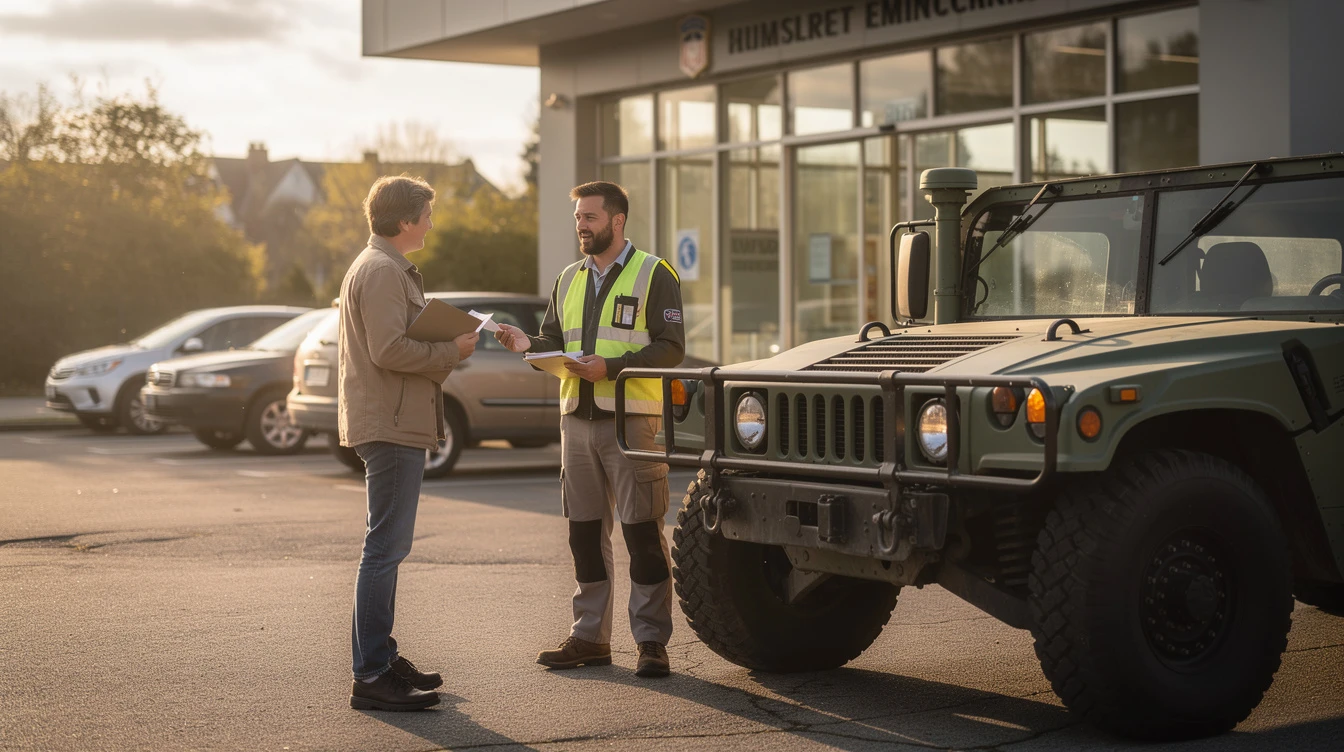
You won the government surplus auction, watched the flatbed roll into your driveway, and stepped out to greet seven thousand pounds of American steel. That High Mobility Multipurpose Wheeled Vehicle, better known as the AM General HMMWV or Humvee, looks incredible parked by the garage. But the moment you take that military bill of sale down to your local clerk counter to get tags, the excitement hits an immediate wall. The clerk stares blankly at the paperwork, consults a supervisor, and informs you that off-road military surplus cannot get road tags in your home state.
It happens far more often than it should. States have grown increasingly strict regarding tactical platforms originally engineered for military service rather than highway travel. Some owners spend months bouncing between inspection stations and regional title bureaus, only to find themselves holding an expensive yard ornament. The good news is that you are not out of options. With the right documentation, proper mechanical equipment, and a clear understanding of out-of-state titling rules, driving your surplus rig on public pavement is entirely within reach.
The Core Hurdles When Registering a Humvee for Highway Travel
Updated on October 9, 2026
Surplus military vehicles do not come with standard civilian paperwork, which creates immediate friction at state title counters. When AM General manufactured these machines under defense procurement contracts, they were built to strict military specifications rather than National Highway Traffic Safety Administration standards. As a result, they never received an automotive certification label or a standard seventeen-character civilian VIN. Instead, they carry a six-character serial number stamped onto an aluminum data plate affixed to the driver side dash or door frame.
when these rigs are decommissioned and sold through surplus auction houses like GovPlanet or IronPlanet, the government issues a Standard Form 97, known as the SF-97. This document acts as the certificate of release of a motor vehicle. In many instances, the auction terms mark the paperwork with restrictive notations such as 'off-road use only' or 'tactical equipment.' State motor vehicle agencies often see those notations and immediately issue a flat denial. A complete understanding of how other platforms cross this barrier can be found in our look at whether Schrödinger's Jeep: What Is the Mahindra Roxor's True Identity?, which tackles similar off-highway classification hurdles.
Certain states take the restriction even further. In states like California, administrative regulations specifically forbid registering surplus tactical platforms regardless of how many civilian safety modifications you install. If you reside in one of these stricter jurisdictions, trying to walk paperwork through your local counter is usually an exercise in frustration. You end up trapped in paperwork loops, chasing supervisory signatures that never arrive.
Curious if this applies to you? Check Your Vehicle Eligibility →
Required Hardware and Street Equipment for On-Road Driving
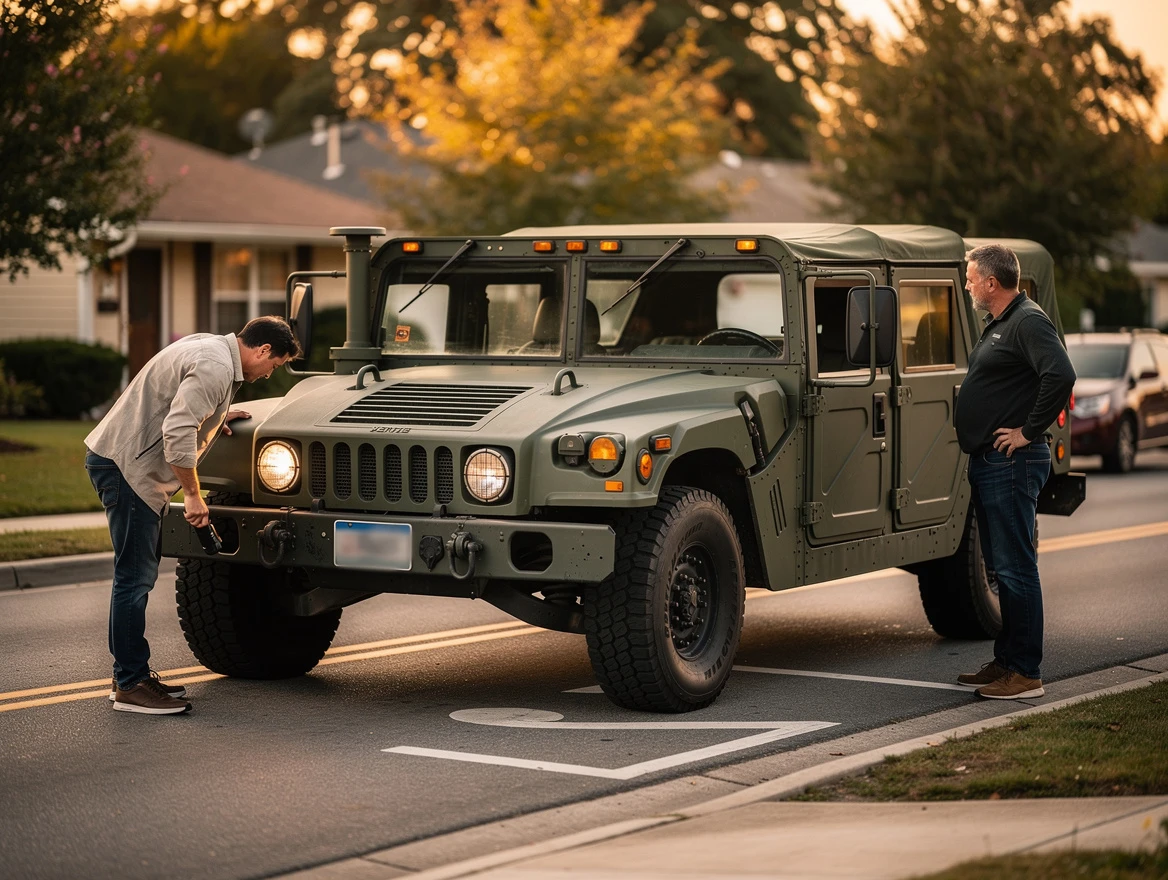
State highway safety regulations dictate that every four-wheeled vehicle traveling on public blacktop must possess specific functional safety equipment. Even if your state allows tactical platforms on the road, an inspection officer will verify that the vehicle complies with baseline highway requirements before passing off on documentation. Fortunately, military Humvees already have several rugged components installed, but you still need civilian-spec upgrades.
Ready to register your vehicle?
Join thousands of vehicle owners who use Dirt Legal to handle their registration quickly.
| Required Equipment | Military Factory Spec | Civilian Road Requirement |
|---|---|---|
| Turn Signals | 24-volt tactical switch | Amber front, red or amber rear flashers |
| Braking System | Inboard hydraulic discs | Fully operational service brake plus manual park brake |
| Tires | Bias-ply or military radial | DOT-stamped highway tread with adequate load rating |
| Mirrors | Dual external side mirrors | Driver side mirror plus center rear or passenger mirror |
| Windshield | Two-piece laminated ballistic glass | DOT-approved automotive safety glass with wipers |
| Lighting | Blackout driving and marker lights | DOT headlights with high/low beams, taillights, plate light |
| Audible Warning | Tactical horn or omitted | Working electric horn audible from two hundred feet |
One notable mechanical detail is the electrical architecture. Surplus Humvees use a 24-volt electrical system, whereas almost all civilian automotive lighting components run on 12 volts. If your auction rig came with non-functional lamps or you need to replace factory blackout lamps with modern DOT-compliant LEDs, you must either source 24-volt road lighting or install an auxiliary 24V-to-12V step-down converter to run civilian accessories. Addressing these lighting and visibility requirements early saves immense time during any required road-worthiness inspection, much like the steps covered in How Do I Build a Car and Make It Street-Legal?.
How Out-of-State Registration Bypasses Local Title Blockers
Montana LLC registration provides a reliable, established path for titling and tagging unique assets like military surplus vehicles. Under Montana law, any individual, regardless of their home state residency, can establish a limited liability company within the state. That Montana LLC is a legitimate entity capable of owning assets, including passenger vehicles, trucks, motorhomes, and surplus equipment. Because Montana has no state vehicle sales tax and does not mandate routine emissions testing or in-person annual physical inspections, it is exceptionally welcoming to non-traditional automotive platforms.
When you register a Humvee under a corporate entity, the state recognizes the entity as the primary owner. This approach resolves the headache of restrictive local DMV policies that flatly refuse tactical military titles. Owners who have hit administrative roadblocks at home frequently turn to Montana LLC Vehicle Registration to get clean plates and transferable ownership paperwork without fighting their local counter staff. Our team assists with the formation of the LLC, coordinates the title filings with state offices, and provides paperwork support to make sure your vehicle is properly documented.
The process is straightforward: first, your corporate entity is created with a registered agent in Montana. Next, the vehicle ownership document, whether an SF-97 with an assigned transfer, a standard title from a prior civilian owner, or an out-of-state certificate, is submitted along with the LLC documents to the county treasurer. The county clerk issues a clean Montana title and license plates to the company. For a broader look at the corporate framework behind this approach, you can read our Montana LLC guide or review how out-of-state titling works on our partner brand page discussing Can You Register a Military Vehicle for Road Use?.
Dirt Legal has completed over 6,000 customer orders to date (lifetime through current month, n=6,341), helping owners across the country establish proper road credentials for unique, hard-to-title vehicles.
Edge Cases, Emission Checks, and Titling Realities
Not every Humvee titling journey follows the exact same script, because auction paperwork and prior owner histories vary wildly. One critical variable is whether your Humvee comes with an unassigned SF-97 directly in your name, an open SF-97 assigned to someone else, or an existing civilian title from another state. If an auction buyer purchased the vehicle and never titled it before selling it to you, that creates an interrupted chain of custody, a situation explained in detail in our article on why Title Jumping is More Illegal Than Jumping a Car. Cleaning up an interrupted paper trail requires proper reassignment or bonded title paperwork.
Another factor involves emissions testing. The venerable naturally aspirated 6.2L and 6.5L Detroit Diesel V8 engines, alongside later 6.5L turbocharged variants, were engineered for harsh combat environments and multi-fuel resilience, not modern clean-air benchmarks. If your home county requires annual tailpipe smog testing or OBD-II electronic diagnostic plug-in checks, a 1993 HMMWV will likely fail or prove entirely ineligible because it lacks an electronic powertrain diagnostic port. Registering in an emissions-exempt jurisdiction removes this obstacle entirely.
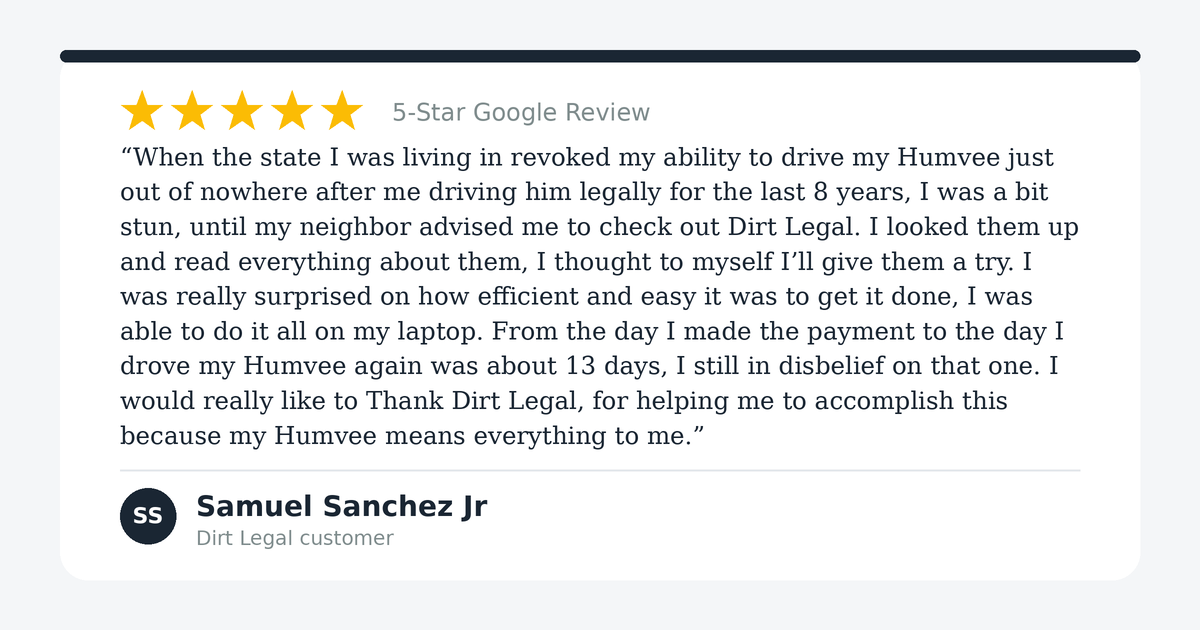
Paperwork challenges can also arise after years of ownership. Here’s one Humvee owner’s experience working with Dirt Legal.
Beyond titling and registration, insurance coverage is another key piece of the puzzle.
Insurance coverage is another key piece of the puzzle. Mainstream standard insurance carriers often hesitate to quote ex-military utility trucks because their computer algorithms do not recognize six-digit chassis serial numbers. Fortunately, specialty collector and vintage military insurers understand these platforms thoroughly. Pairing specialty agreed-value liability and collision coverage with out-of-state tags ensures you are fully protected out on public roads. You can learn more about how specialized paperwork workflows operate by looking at How Street Legal Works.
Getting Your Surplus Rig on the Asphalt
Owning a military Humvee is an unmatched automotive experience. The wide stance, geared portal hubs, and unmistakable presence turn heads in every parking lot and trail staging area across the country. But parking seven thousand pounds of iconic American military engineering in your driveway without the right to drive it to the store or off-road trailhead defeats the purpose of buying it in the first place.
Instead of letting confusing local statutes and uncooperative local clerk counters stall your progress, use proven pathways that make driving on public roads possible. Whether you are dealing with a fresh SF-97 straight out of a military base auction or an older title that has been stalled by state paperwork, you do not have to fight the bureaucratic maze by yourself. Let our team do the heavy lifting so you can focus on enjoying the drive.
Ready to take the next step? We can help. Register Your Vehicle Today →
Frequently Asked Questions
Are military humvees street-legal?
Surplus military Humvees are not street-legal right out of the box because they were manufactured to tactical defense standards rather than Federal Motor Vehicle Safety Standards (FMVSS). However, they can be made road-worthy and registered for street use by adding essential civilian safety equipment such as DOT-approved lighting, horn, mirrors, and wipers, and by submitting the proper ownership paperwork through a state that allows tactical vehicle registration.
Can you register an atv for street use?
Yes, many states allow ATVs and UTVs to be registered for on-road use, provided they are modified with road-safety equipment like turn signals, headlights, rearview mirrors, and a horn. In states that strictly prohibit off-highway vehicles on public roadways, owners routinely register their machines through out-of-state mechanisms such as a Montana LLC to secure street plates.
Can you buy a military humvee?
Yes, civilians can purchase surplus military Humvees through government liquidators and online surplus auction platforms such as GovPlanet and IronPlanet. Buyers must be US citizens and typically must complete an End-Use Certificate (EUC) before the Defense Logistics Agency releases the vehicle for civilian transport.
Are military humvees reliable?
Surplus Humvees are mechanically and simple to work on, featuring heavy-duty drivetrains, portal gear hubs, and mechanical diesel injection systems. However, because they endured demanding military service and often sat in storage yards for years, they frequently require mechanical refreshes including fluid flushes, new seals, glow plugs, and steering component rebuilds before achieving consistent daily reliability.
Do military humvees have ac?
Most standard military Humvees do not come equipped with factory air conditioning. A few later armored variants and specialized command configurations received supplemental rooftop or rear-mounted military cooling units, but the vast majority of surplus rigs feature basic sliding canvas or hard-door vent windows. Many owners install aftermarket 24V or 12V civilian air conditioning kits to improve cabin comfort.
Do you register military trailers?
Yes, military surplus trailers like the M101, M1101, and M1102 must be titled and registered to be towed on public highways. Just like the vehicles themselves, surplus trailers are sold with an SF-97 or government bill of sale and require working DOT-spec taillights, safety chains, and appropriate license plate registration before hitchedup highway travel.