Grasshopper Kei Truck Camper at SEMA 2026: Full Specs
Grasshopper kei truck camper at SEMA 2026: Hijet Jumbo base, 11-drawer kitchen, pop-up tent, full specs and how to import a similar kei truck.
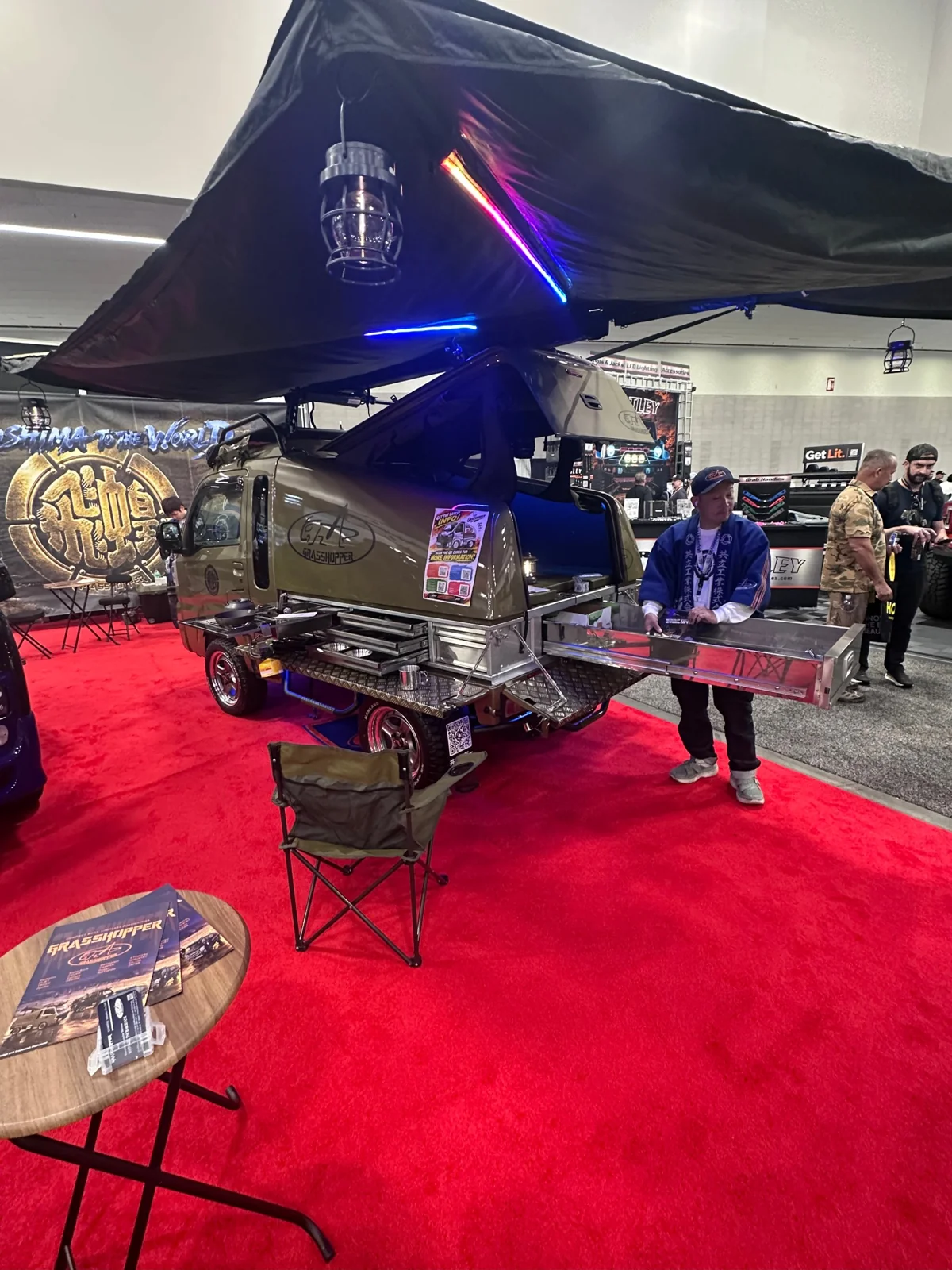
The Grasshopper Camper is a Daihatsu Hijet Truck Jumbo (S510P) converted into a compact camper by Kyoritsu Industry Co., Ltd. of Hiroshima, Japan. It was one of two Grasshopper builds shown at SEMA 2026 in Las Vegas, and it fits an 11-drawer kitchen cabinet system, a pop-up tent and a 270-degree awning onto a kei truck with a 660cc engine.
If you want to import or buy a similar kei truck, Dirt Legal can help.
Get Started →Grasshopper Camper Specifications
Updated on November 24, 2026
| Item | Detail |
|---|---|
| Name | Grasshopper, SEMA Show Edition, Type: Camper |
| Base vehicle | Daihatsu Hijet Truck Jumbo, model S510P, 2026 model year |
| Engine | 660cc, 3-cylinder DOHC with DVVT |
| Power | 48 PS (about 47 hp) |
| Transmission | Automatic |
| Top speed | 120 km/h (about 75 mph) |
| Max payload | 350 kg (about 770 lb), base truck rating |
| Suspension | 50 mm (about 2 in) lift with adjustable coilovers |
| Builder | Kyoritsu Industry Co., Ltd., Hatsukaichi City, Hiroshima, Japan |
Can You Import or Buy a Kei Truck Like This?
How do you import a kei truck? A kei truck can be imported into the US when it is at least 25 years old, counted from its manufacture date, and meets the EPA emissions rules, which use a 21-year test. After it clears customs, your state decides whether the truck can be titled, registered and driven on public roads.
The exact truck in these photos is a brand-new 2026 show vehicle, so it cannot come in under the federal 25-year import rule. That NHTSA rule exempts vehicles at least 25 years old from federal safety standards, counted from the date of manufacture. The EPA has a separate emissions exemption for vehicles at least 21 years old in original configuration.
Older kei trucks from the same family are a different story. A Hijet, Carry, Acty or Sambar that meets the age rules can be imported, and many owners add their own camper, canopy or lift kit afterward.
The federal rule is only the first step. Each state sets its own titling, registration and road-use rules, and some states limit kei trucks to off-road use or lower-speed roads. Check your state's rules before you buy.
How Dirt Legal Can Help
Dirt Legal is a private company, not a DMV or part of any state government. If you want to import or buy a kei truck, or another vehicle in this family, we are able to help with registration paperwork assistance, title assistance and Montana LLC support where it fits your situation. Tell us the vehicle, the model year and the state where you live, and we will walk you through what the process looks like.
What Is a Kei Truck?
A kei truck is a small cab-over pickup that fits Japan's kei car class, which limits engine size and vehicle dimensions. The Daihatsu Hijet is one of the best-known examples. Other popular kei trucks include the Suzuki Carry, Honda Acty and Mitsubishi Minicab. In the US, owners use them on farms, ranches, job sites and campuses, and more and more as a base for camper builds like this one.
What Is Built Into the Grasshopper Camper?
Exterior
- Slant-back canopy made from GFRP (fiberglass-reinforced plastic)
- Adjustable stainless steel roof rack
- WAS LED light bar and LED driving lamp in a Polish Euro design
- Stainless steel front bumper guard, side steps, rear step bumper and battery cover
- Aluminum checker plate over-fenders, front and rear
- 270-degree awning with built-in LED lights
Interior and Camp Gear
- Cabinet system with 11 drawers and a built-in kitchen bench
- Original seats
- Cab-back cutout modification
- Pop-up tent
- LED room lamp
Wheels, Tires and Ride Height
The truck sits 50 mm higher on adjustable coilovers. It rolls on WORK Equip 40 alloy wheels in 15 inches, with different widths front and rear: 6.0J with a +42 offset in front and 6.5J with a +23 offset in the rear. Nankang FT-9 mud-terrain tires with raised white letters finish the look, in 185/60R15 up front and 195/65R15 in the back.
Why Kyoritsu Brought It to SEMA
According to Kyoritsu's own announcement, the company showed two Grasshopper trucks at SEMA 2026, the Camper and a Sports Mechanic, at the Las Vegas Convention Center. Its first goal was to meet potential business partners for overseas import, sales and manufacturing, and to build awareness of the Grasshopper brand. The show theme was "Hiroshima to the World."
Frequently Asked Questions
What is the Grasshopper kei truck camper?
It is a Daihatsu Hijet Truck Jumbo (S510P) converted by Kyoritsu Industry Co., Ltd. into a camper with a slant-back canopy, an 11-drawer kitchen cabinet system, a pop-up tent and a 270-degree awning.
How much power does the Grasshopper Camper have?
It uses the Hijet's 660cc 3-cylinder DOHC engine with DVVT, rated at 48 PS (about 47 hp), with an automatic transmission and a top speed of 120 km/h (about 75 mph).
How much can the Grasshopper Camper carry?
The base Hijet Truck Jumbo is rated for a maximum payload of 350 kg (about 770 lb). The canopy, tent, drawers and gear all use part of that, so the usable payload of the finished build is lower.
Can I buy the Grasshopper Camper in the US?
Kyoritsu showed it at SEMA to meet potential partners for overseas import, sales and manufacturing. At the time of writing we have not seen a US sales announcement, so check with the builder for availability.
Can I import a kei truck into the US?
Kei trucks at least 25 years old, counted from manufacture date, can be imported under the NHTSA 25-year rule, and the EPA uses a 21-year test for emissions. After import, your state decides whether and how the truck can be titled, registered and driven on public roads.
Are kei trucks street-legal in every state?
No. Rules vary by state. Some allow road use, some limit kei trucks to lower-speed roads and some restrict them to off-road use.
Does Dirt Legal help with kei truck registration?
Yes. We can help with registration paperwork and title assistance for imported kei trucks and similar vehicles. This post is general information, not a substitute for guidance from your state.