Can You Make a UTV Street Legal in Oregon? What You Need to Know
Can you make a UTV street legal in Oregon? What you need to know about ODOT rules, equipment requirements, and out-of-state Montana LLC registration paths.
You cannot directly register a standard utility terrain vehicle (UTV) or side-by-side for unrestricted on-road highway driving through the Oregon Driver and Motor Vehicle Services (DMV). Oregon Department of Transportation (ODOT) regulations classify side-by-sides as Class I or Class IV all-terrain vehicles (ATVs), restricting them to off-highway vehicle (OHV) trails, designated public lands, and specific local rural secondary roads with special permits. Enthusiasts looking to drive on public roads compliantly often turn to out-of-state registration pathways, such as establishing a Montana LLC holding company to obtain a regular license plate and registration document recognized under interstate reciprocity agreements.
Understanding state off-highway classifications, required safety hardware, and alternative out-of-state paperwork processes allows you to operate your side-by-side without unwanted roadside surprises. Here is everything required to understand the statutes, hardware configurations, and paperwork channels available today.
Oregon Law Prohibits Direct In-State Street-Legal UTV Registration
Updated on September 24, 2026
Oregon Revised Statutes (ORS 801.190 and ORS 801.193) define all-terrain vehicles strictly under recreational off-road classes, explicitly separating them from passenger motor vehicles. Because factory side-by-sides lack federal motor vehicle safety standards (FMVSS) certification from the Department of Transportation, local Oregon DMV branches will not issue a standard passenger or light-truck road title or license plate for a UTV.
Instead, the state mandates that owners obtain an Oregon State Parks OHV operating permit decal to ride on public designated lands. While you can drive across designated rural roadways connecting marked trail heads at 20 miles per hour or lower, standard street use remains off-limits through direct in-state titling.
Why Oregon Restricts Side-by-Side Highway Operation
Oregon vehicle safety codes require on-road passenger vehicles to meet stringent federal crash-test parameters, windshield impact ratings, and specific emissions thresholds. Utility task vehicles leave the factory stamped with an off-highway vehicle certification label from the manufacturer. Because this designation indicates the chassis was engineered exclusively for off-pavement utility and recreation, the Oregon DMV flags the vehicle identification number (VIN) automatically during any in-person titling attempt.
Local Road Allowances Under Oregon County Ordinances
Certain rural counties, including portions of Coos, Lake, and Klamath counties, have enacted localized jurisdictional exceptions permitting limited ATV and UTV operation on select secondary county routes. These local allowances generally mandate daytime operation only, posted speed caps between 20 and 25 miles per hour, an active driver license, and proof of state-mandated liability insurance. However, these local allowances do not translate to statewide road privileges or permit you to merge onto state routes, urban boulevards, or multi-lane highways.
Required Hardware and Safety Gear for Road Compliance
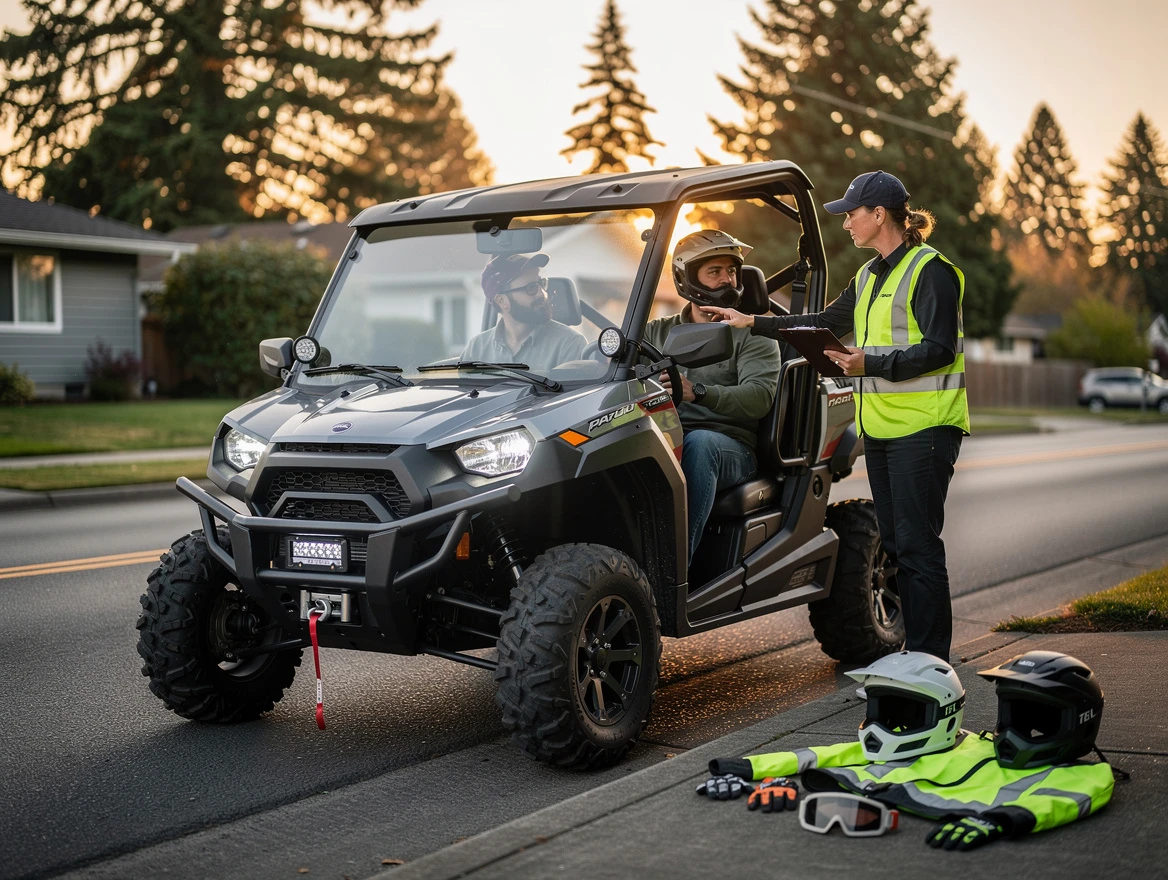
Whether you operate under a localized rural county road permit or drive with out-of-state plates under interstate reciprocity, your machine must feature essential safety equipment to share the road safely with passenger traffic. Modern side-by-sides require targeted aftermarket additions before crossing onto asphalt surfaces.
Ready to register your vehicle?
Join thousands of vehicle owners who use Dirt Legal to handle their registration quickly.
Building out a machine for road-readiness involves adding Department of Transportation (DOT) compliant components that give nearby drivers clear visual signals and provide adequate visibility day or night. If you want a deeper look at specific hardware, consult our guide on parts and equipment for outfitting off-highway machines.
Mandatory Lighting and Signalling Upgrades
Standard factory trail lights rarely satisfy highway visibility standards. To make your platform safe and compliant for road travel, you need headlights with dedicated high and low beam functionality, red tail lights, active brake lights illuminated by the foot pedal, and amber turn signals visible from at least 100 feet away. You must also mount an illuminated white license plate bracket so registration tags remain clearly visible in low-light environments.
Mirrors, Windshields, and Audible Warning Devices
Rear-view visibility is non-negotiable when operating on open roadways. Most road jurisdictions demand at least two functional mirrors, consisting of an adjustable interior center mirror combined with a driver-side exterior mirror or two distinct side-view mirrors. you will need an electric horn audible from a distance of 200 feet and either an impact-resistant DOT-approved safety glass windshield with a manual or electric wiper, or approved safety eye protection for every vehicle occupant.
Tires, Seatbelts, and Mechanical Standards
Aggressive off-road knobby tires present severe handling compromises on hot asphalt and often lack the DOT road certification stamp on the sidewall. Equipping your vehicle with DOT-rated all-terrain or radial street tires improves braking traction, dampens high-speed vibration, and satisfies highway patrol vehicle inspections. Additionally, every passenger seating position requires a factory three-point seat belt or a secure multi-point use system anchored firmly to the roll cage frame.
How Out-of-State Registration Works for Oregon Residents
Since the local Oregon DMV does not offer a pathway to convert an off-highway vehicle into a road-going platform, many enthusiasts turn to out-of-state paperwork solutions. Forming a business entity in an asset-friendly state like Montana allows the company to compliantly own and register the side-by-side, obtaining a valid highway title and permanent license plate.
Through our dedicated Montana LLC Vehicle Registration process, owners can hold their powersport assets within a corporate entity without needing personal physical residency in the state. Dirt Legal assists with the filings to establish your entity, prepare state application documents, and transfer titling paperwork directly through the state agency.
Interstate Reciprocity and Operating Out-of-State Plates
The United States Constitution incorporates a Full Faith and Credit clause, which instructs states to recognize issued registrations, plates, and titles originating from other jurisdictions. When your vehicle displays authentic out-of-state plates and carries valid registration paperwork registered to your company, law enforcement officers can verify the vehicle identity directly via national database lookups. Reviewing Can You Register a Vehicle in a State You Don't Live In? provides helpful clarity on multi-state ownership structures.
Titling Paperwork and Ownership Verification
To transfer an off-highway platform to an out-of-state title, you need clean proof of ownership. This typically includes the original Manufacturer Certificate of Origin (MCO), a clean prior state title, or a properly executed bill of sale. For enthusiasts holding incomplete documentation, learning how to title a vehicle without a title: legitimate options and documents needed helps establish acceptable paperwork before submitting records to the state.
You should also make sure your seller signed off completely on previous ownership forms. As discussed in Seller Forgot to Sign Title? Here Is What You Do Now, missing signatures can stall processing timelines before your registration document arrives.
Comparing In-State Oregon Rules vs. Out-of-State Registration
Deciding how to operate your side-by-side depends entirely on where and how frequently you intend to ride. The comparison table below highlights the operational differences between relying exclusively on native Oregon OHV permits versus establishing out-of-state vehicle registration.
| Operational Category | Native Oregon OHV Permit | Out-of-State Montana LLC Registration |
|---|---|---|
| Permitted Road Types | Designated trails and select rural county roads | Public surface streets, county roads, and highways |
| Speed Caps | Strictly capped at 20-25 MPH locally | Normal posted highway traffic speeds |
| Required Hardware | Spark arrestor, flag, basic trail lighting | Full street kit: turn signals, horn, DOT mirrors, plate light |
| Annual Renewals | Two-year OHV permit sticker renewal | Permanent powersports registration options available |
| Interstate Driving | Limited to reciprocal trail systems only | Recognized for travel nationwide across state borders |
To verify motor vehicle statutes and official administrative rules governing out-of-state entity formation, consult the Montana Motor Vehicle Division or search business filing standards directly through the Montana Secretary of State, Business Entity Search.
See How We Can Help With Your Street-Legal registration →
Insurance, Titling Chains, and State Compliance Considerations
Operating a road-going side-by-side involves more than mounting plates to the frame. You must also maintain compliant liability insurance and make sure your platform never becomes tangled in questionable ownership documentation.
When purchasing a pre-owned machine, make sure the seller holds the title in their name. Engaging in unchecked private deals can expose buyers to the penalties surrounding title hopping. Read our breakdown on Title Isn't Always Ownership: The Reality Most People Miss to understand how chains of custody protect your vehicle investment.
Securing Proper On-Road Insurance Coverage
Standard off-road liability policies designed for recreation do not satisfy highway financial responsibility statutes. When licensing your platform for open-road driving, you must adjust your insurance coverage to an on-road or dual-purpose motorcycle/powersports policy. The policy must list the registered owner, whether yourself or your corporate entity, and explicitly cover on-road use across all public highways.
As highlighted in Your Exotic Car's Insurance Is Only as Strong as Its Registration, keeping registration documents and insurance underwriting strictly aligned prevents coverage issues in the event of a roadside collision or property damage claim.
Avoiding Title Errors and Incomplete Transfers
Never accept an open title or incomplete bill of sale when acquiring a side-by-side from a third party. If a prior owner neglected to transfer documentation through proper channels, resolving the title history requires additional administrative steps. Look at The Most Common Mistakes People Make Titling Custom Vehicles to identify paperwork stumbling blocks early in your acquisition process.
Choosing our Street-Legal Vehicle registration assistance services ensures your documents receive careful review before submission. Dirt Legal has completed over 6,000 customer orders to date (lifetime through current month, n=6,199), assisting enthusiasts nationwide with simplified paperwork processing and vehicle registration support.
You can also check other state processes across the country to compare how jurisdictions address conversions by reading our complete national review on how to make a UTV street-legal by state or reviewing How to Make a UTV Street-Legal in 2026: Efficient Guide.
Frequently Asked Questions
How to make a utv street-legal?
Making a UTV street-legal requires outfitting the machine with required street-safety equipment and obtaining a valid on-road title and license plate. Necessary mechanical upgrades include DOT-approved tires, high and low beam headlights, turn signals, brake lights, mirrors, a horn, a lighted license plate bracket, and a windshield or approved eye protection. Because many local DMVs do not register off-highway vehicles for highway driving, owners often use an out-of-state registration process, such as establishing an out-of-state LLC, to obtain compliant on-road tags recognized under reciprocal travel agreements.
Can you make a dirt bike street-legal?
Yes, dirt bikes can be made street-legal provided they are outfitted with on-road safety equipment and successfully titled as a street-compliant motorcycle. Required components include a DOT-compliant headlight with high and low beams, functional taillight and brake light, rearview mirrors, turn signals, a horn, and DOT-rated road tires. If your home state DMV restricts conversions based on an off-highway MSO label, third-party paperwork assistance services can assist in securing an out-of-state motorcycle title and plate.
Can you make a go kart street-legal?
Making a traditional go-kart street-legal is exceptionally difficult due to strict structural and safety standards. Most state vehicle codes classify standard go-karts as non-compliant recreational toys lacking the roll cages, bumpers, lighting, braking performance, and ground clearance required for road vehicles. However, purpose-built mini-cars or custom tube-frame buggies that feature full roll protection, FMVSS lighting, mirrors, seat belts, and proper braking can occasionally be titled under custom-built, assembled, or low-speed vehicle (LSV) classifications depending on specific state statutes.
What does a side-by-side need to be street-legal?
To Eligible for road use, a side-by-side must possess both physical street equipment and valid on-road registration documents. Mechanically, the vehicle needs DOT-rated tires, working headlights with low and high beams, taillights, brake lights, functional turn signals, illuminated license plate mounts, dual rearview mirrors, a horn audible for 200 feet, seat belts, and an impact-resistant windshield or safety eyewear. Administratively, the vehicle must hold a state-issued passenger or street-utility vehicle title, an active registration card, visible metal license plates, and active road liability insurance.
Can you make a side by side street-legal in pa?
Pennsylvania does not allow direct in-state road registration for side-by-sides through the Pennsylvania Department of Transportation (PennDOT). Pennsylvania classifies side-by-sides as ATVs, limiting them to private property, designated state forest trails, and select local connector roads during designated seasons. Pennsylvania residents who wish to drive their machines on public highways typically register their vehicle through an out-of-state entity holding company, such as a Montana LLC, allowing them to carry compliant out-of-state plates and drive on public roads.
How to make a race car street-legal?
To transition a track-only or purpose-built race car to the street, the vehicle must meet all fundamental highway safety standards and hold a valid road title. You must install street-compliant equipment, including DOT-approved radial tires, working headlights, turn signals, brake lights, hazards, mirrors, an audible horn, emergency parking brakes, and an exhaust system meeting noise and environmental regulations. If the race car was acquired on a bill of sale without a road title, you must work through an assembled-vehicle titling inspection or register through an asset-friendly state to establish road-going ownership documents.
Can I drive an Oregon-permitted OHV on state highways?
No, an Oregon State Parks OHV operating permit does not grant permission to drive on state highways, interstates, or standard municipal streets. The permit only allows access to designated public trail systems, open dunes, and specific local public roads designated by county commissioners. Crossing an open highway is permitted only at a direct 90-degree angle where visibility is clear, the machine comes to a complete stop first, and local laws specifically permit crossing.
Will Oregon police accept an out-of-state Montana LLC plate?
Yes, Oregon law enforcement recognizes validly issued out-of-state registrations under interstate reciprocity, provided the vehicle meets basic road safety equipment rules and carries current registration cards matching the entity name. Officers can run the plate number through standard dispatch channels to confirm the registration status in the issuing state database. Always make sure your proof of insurance matches the registered owner entity precisely to avoid administrative issues during a routine traffic stop.
Start Your Registration Today →
When asking can you make a UTV street-legal in Oregon, what you need to know is that state-level DMV restrictions do not have to keep your machine chained strictly to off-road parks. By outfitting your platform with proper DOT-rated safety equipment and leveraging an out-of-state corporate titling structure, you can gain open-road access and enjoy your side-by-side on public asphalt compliantly.